TL;DR
Process mining is a way of using the event logs already held in your ERP, CRM, finance and ticketing systems to see how work really flows through the business, step by step, rather than how everyone assumes it flows. For UK operations leaders it is the quickest way to find the delays, rework and repetitive tasks worth fixing or automating before spending money on AI. A first project usually takes six to ten weeks and starts with one process, such as order-to-cash or purchase-to-pay.
Last updated: 2 October 2026
Process mining has become the sensible first step for businesses that want to automate but are not sure where to start. Most COOs can describe how an order is meant to move from quote to invoice. Far fewer can say how many orders actually follow that path, where they stall, or how much time is lost to people chasing, re-keying and correcting data.
That gap matters more now that automation is mainstream. The British Chambers of Commerce found that 54% of UK firms are now actively using AI, yet many are applying it to tasks chosen by instinct rather than evidence. Automating a broken process simply produces mistakes faster.
This guide explains what process mining is, what it finds, how a practical project runs in a scale-up, and who should lead it.
What is process mining?
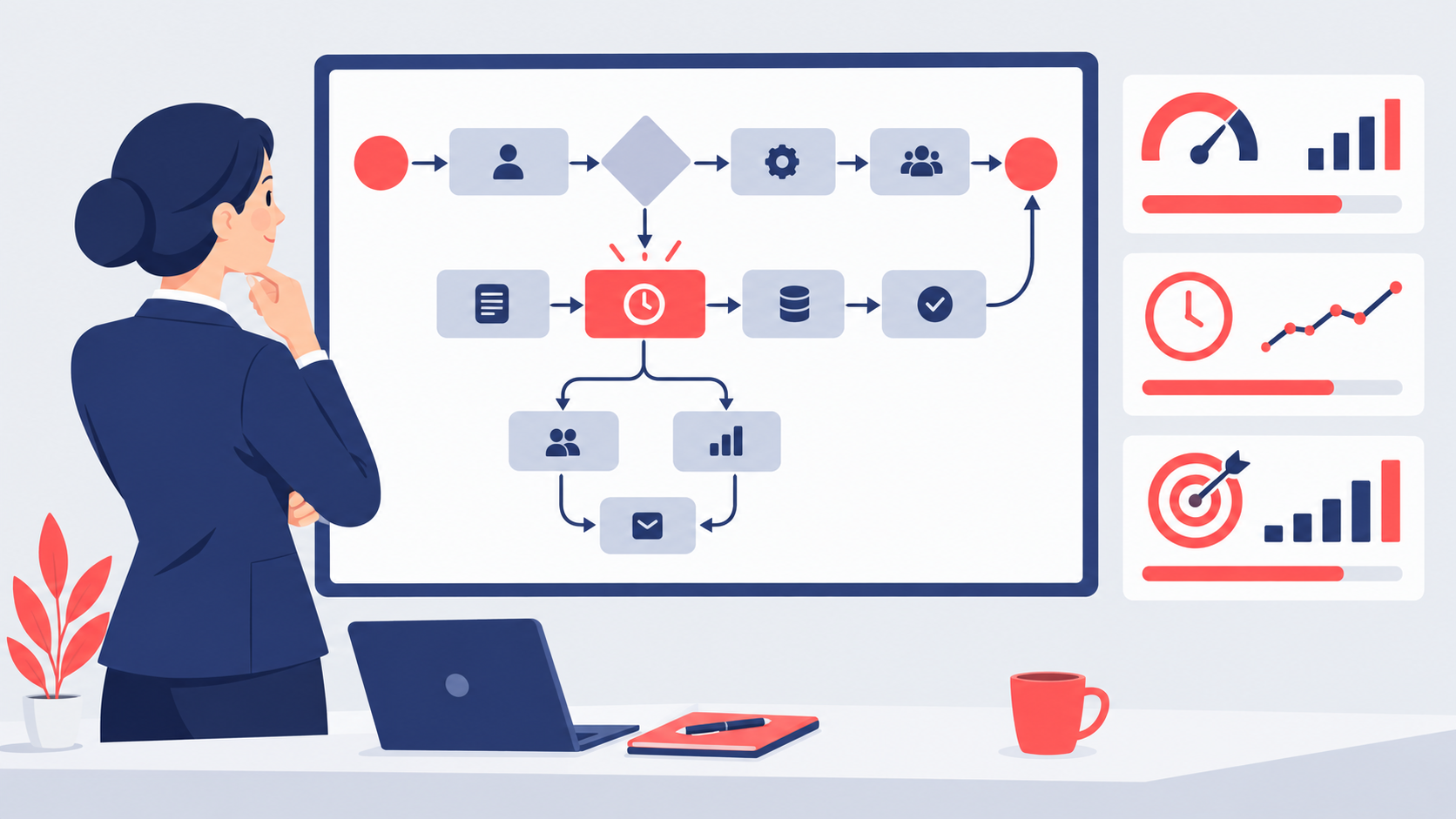
Gartner defines process mining as a technique designed to discover, monitor and improve real processes, not assumed ones, by extracting knowledge from the event logs of information systems. Every time someone creates an order, approves an invoice or closes a support ticket, your systems record what happened, to which case, and when. Process mining stitches those records together into a map of every route each case actually took.
The discipline grew out of academic research and is promoted by the IEEE Task Force on Process Mining, whose manifesto sets out three core uses: discovering how a process runs, checking it against how it should run, and improving it. Modern tools add dashboards, alerts and simulation, but the principle is unchanged.
It is often confused with task mining. Process mining looks across systems at the end-to-end flow of a case. Task mining zooms in on what individual people do on their desktops, such as copying data between screens. The two work well together, but process mining should come first because it tells you which tasks are worth looking at.
What process mining reveals: the benefits for UK businesses
The value comes from replacing opinion with evidence. Typical findings in the first project include:
- Hidden variation — a process everyone thinks has five steps often runs dozens of different ways, each with its own cost and delay.
- Bottlenecks with a cause — not just that invoices are slow, but that 30% wait at one approval step for a named reason.
- Rework loops — orders that bounce back to sales, purchase orders that are amended repeatedly, tickets reopened after closure.
- Automation candidates ranked by value — high-volume, rule-based steps where automation pays back quickly.
- Compliance gaps — payments made before approval, or segregation-of-duties rules being bypassed.
- A baseline to measure against — so you can prove that an automation or system change actually worked.
- Better ERP decisions — evidence of how the current system is really used before you replace or reconfigure it.
How a process mining project works in practice
Start with one process that matters commercially and has good data, such as order-to-cash, purchase-to-pay or customer onboarding. Extract the event logs from the systems involved, which usually means a case reference, an activity name and a timestamp for each step. Clean and combine them, then load them into a process mining tool. For a first project, mid-market tools or even open-source options are often enough.
The first map is usually a surprise. Spend two or three weeks interpreting it with the people who run the process, because the data shows what happened but not always why. Agree three or four changes, make them, and measure again. A realistic first cycle takes six to ten weeks.
Picture a 120-person distribution business whose cash collection had slowed. Process mining of its order-to-cash flow showed that almost a fifth of invoices were issued with missing purchase order numbers, so customers rejected them and the team re-issued them by hand. A simple validation rule at order entry, followed by an automated reminder, cut debtor days without hiring anyone. Only then did the business automate the remaining manual steps.
Our guide to where to start with business process automation covers what to do once you know which steps to automate.
Who should lead process mining, and how to choose help
Process mining fails when it is treated as an IT reporting project. The person leading it needs authority over the process, an understanding of the systems it runs on and the credibility to change how teams work. In many scale-ups that is the COO or operations director, supported by someone who can extract and clean the data.
When choosing outside help, look for experience of your systems (Sage, Xero, Dynamics, SAP or a sector ERP), a clear plan to start with one process rather than a platform licence, evidence of measured operational results rather than impressive maps, and no long-term tie-in. Be wary of anyone who recommends an expensive tool before seeing your data.
If you do not have that operational leadership in-house, a fractional COO or a data and AI leader working a few days a month can run the first project, and our AI consultancy service can then build the automations the evidence points to.
Frequently asked questions
What data do I need for process mining?
Is process mining only for large enterprises?
How much does process mining cost?
What is the difference between process mining and process mapping?
Should process mining come before automation or AI?
Ready to find out how your processes really run?
Leadership Services gives UK scale-ups access to a bench of 500+ senior directors, including operations and data leaders who can run your first process mining project and turn the findings into results. Engagements start from £1,795 per month, begin within one week and have no long-term tie-ins — get in touch and we will respond the same working day.