
Last updated: 29 April 2026
Investor Readiness for UK Scale-Ups: A Fractional Director’s Checklist
Investor readiness for UK scale-ups is the work of preparing your business so that an investor can complete due diligence quickly, confidently, and at the valuation you want. It is the difference between a 12-week raise and an 18-month grind. UK venture capital firms now spend an average of 118 hours on due diligence per investment and over 20 hours per potential deal even before term sheets land (Henderson Loggie). The companies that win funding in 2026 are not necessarily the ones with the best products. They are the ones whose financial reporting, governance, and growth narrative stand up under that level of scrutiny.
This guide sets out the practical investor readiness checklist that fractional finance and operations directors use with UK scale-ups preparing for Series A, Series B, growth equity, or strategic investment. It covers what investors actually look for, the most common gaps, and how part-time senior leadership closes them.
What does investor readiness for UK scale-ups actually mean?
Investor readiness has a narrow technical meaning and a broader strategic one. The technical meaning is a complete data room: financials, contracts, cap table, governance, and compliance documentation organised and ready to share. The strategic meaning is a coherent story that links the numbers to the market opportunity, the team, and the use of funds.
UK investors, particularly at Series A and beyond, expect both. According to Equidam’s analysis of the 2025 UK funding landscape, traction expectations now require double or triple-digit year-over-year growth, with 15 to 20 percent month-over-month growth for early-stage companies, plus strong unit economics and defensive competitive positioning (Equidam UK Startup Funding 2025 Guide). Companies that arrive at a pitch without that evidence rarely make it past the first call.
Investor readiness for UK scale-ups is therefore not a documentation exercise. It is a business preparation exercise that produces, as a by-product, a defensible data room.
The eight pillars of investor readiness for UK scale-ups
The UK Government’s investor readiness framework, published as part of the Unlocking Space for Investment Growth Hub, identifies eight areas that investors evaluate (GOV.UK Track 1 Investor Readiness Essentials). They apply equally well to private investors evaluating any UK scale-up.
- A clear vision driving credibility in the market. Founders who cannot articulate purpose, ambition, and direction in two sentences struggle to inspire investor conviction.
- Articulation of the customer proposition. Benefits over features. The pain you remove, not the product you ship.
- The right management team. Balanced commercial, operational, technical, and financial expertise. Investors back people, not slides.
- Demonstrated traction. Pipeline evidence, signed contracts, paid pilots, and revenue projections grounded in conversion data.
- Evidence-backed market sizing. TAM, SAM, and SOM rooted in third-party data, not assumption.
- Focused initial market niche and competitive differentiation. Where you win first, and why.
- Aligned story across financial, governance, and team. The numbers, the structure, and the people tell the same story.
- Sector-aligned growth plan with strong upside. Specific levers, specific timelines, specific outcomes.
The pattern that separates strong UK scale-ups from weaker ones is consistency. The pitch, the model, the management accounts, and the cap table all reinforce each other. Investors detect inconsistency in minutes.
The fractional director’s investor readiness checklist
The practical checklist below is what fractional finance and operations directors use when preparing UK scale-ups for funding. It mirrors what investors will probe during due diligence.
- Real-time financial dashboards. Not month-old spreadsheets. Investors expect live MRR, ARR, churn, gross margin, and cash runway.
- Proper management accounts. Monthly P&L, balance sheet, and cash flow at department or product line. Bookkeeping alone is not enough.
- Clear unit economics. CAC, LTV, payback period, and contribution margin per customer cohort. Broken unit economics at small scale will fail at large scale.
- Documented processes. Operating procedures, decision rights, and key workflows captured in writing, not in the founder’s head.
- Two-week founder absence test. The business runs cleanly without the founder for two weeks. Tested in practice, not theory.
- Strategic acquisition shortlist. A list of strategic buyers and their investment thesis. Investors want to know your exit logic.
- Scalable systems. Tech stack, data architecture, and reporting that grow with the business, not founder-dependent workflows.
- Departmental leadership in place. Sales, operations, and finance led by people other than the founder.
- 12-month growth trajectory mapped. A specific bridge from current performance to forecast, with assumptions tied to evidence.
- Exit strategy defined. Even at Series A, investors expect a credible exit narrative for five to seven years out.
Most UK scale-ups score four or five out of ten on this list when they first start preparing to raise. The work of investor readiness is closing the gap on the remaining items before any pitch goes out.
The data room: what UK investors expect
A clean data room signals operational maturity faster than any deck. Blick Rothenberg, working with UK scale-ups across multiple Series A and B rounds, identifies the documents investors expect available within 48 hours of term sheet (Blick Rothenberg on fundraising due diligence).
- Financial. Two years of audited or independently reviewed accounts, monthly management accounts, three-year forecast model with assumption documentation, current cap table, debt schedule, and tax compliance evidence.
- Commercial. Top-20 customer contracts, supplier contracts, sales pipeline with conversion data, customer retention cohort analysis, and competitive landscape map.
- Legal. Articles of association, shareholders’ agreement, employment contracts for key staff, IP register, GDPR compliance evidence, and any material litigation or disputes.
- Operational. Organisation chart, key person dependencies, operating procedures, technology architecture, and data security policies.
- Governance. Board meeting minutes, board pack examples, advisory arrangements, and any non-executive director contracts.
The single most common reason a UK scale-up loses momentum during due diligence is patchy documentation. Investors who have to chase missing files, or who find inconsistencies between the deck and the data room, will either reprice the deal or walk. Building the data room before going to market eliminates that risk.
How a fractional director closes investor readiness gaps
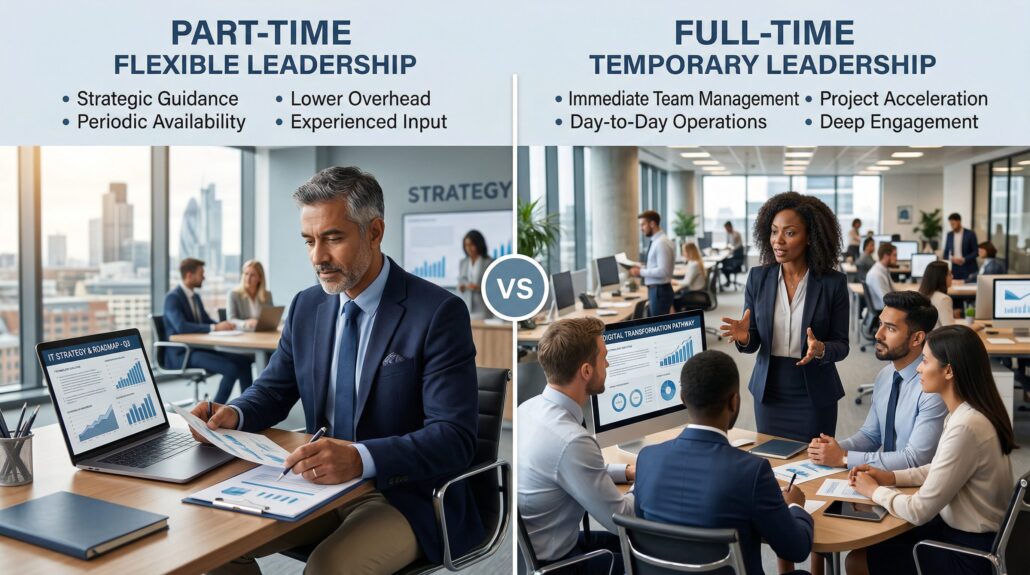
Most UK scale-ups raising Series A or growth capital do not have an in-house CFO, COO, or non-executive chair. A fractional director provides that senior leadership for two to four days a month over the six to twelve months before a raise.
The work falls into four streams. First, building the financial foundation: management accounts, KPI dashboards, unit economics, and the forecast model. Second, structuring the data room and stress-testing every document against the questions investors will ask. Third, supporting the founder during pitches and diligence calls, providing the senior counterpart investors expect to see. Fourth, advising on deal structure, valuation, and term sheet review when offers arrive.
The economics are straightforward. A fractional finance director engaged for the year before a raise typically costs 10 to 20 percent of a permanent CFO and adds materially more value than a junior in-house hire who has never been through a funding round. Our part-time finance director service is structured around this work, and our directors have personally led raises of £1 million to £25 million across UK technology, services, and consumer businesses.
For founders who also need senior commercial or operational leadership during the raise, our fractional COO services provide complementary support on the operational readiness side of the checklist.
Common investor readiness mistakes UK scale-ups make
Five mistakes recur across UK scale-up raises and each costs founders either time, valuation, or both.
- Pitching too early. Scale-ups that approach investors before completing the readiness work waste months on conversations that go nowhere and damage their reputation in the market.
- Treating the deck as the deliverable. A polished deck without a defensible model behind it falls apart in due diligence. The model is the deliverable; the deck is the summary.
- Hockey-stick forecasts. Unrealistic projections destroy trust faster than weak ones. Investors price down or walk away from forecasts they cannot defend internally.
- Founder-only fundraising. Founders running the raise alone, without senior finance support, miss preparation steps and negotiate from a weaker position.
- Ignoring governance. Companies without a board cadence, board packs, or advisory structure look immature. Investors want to see governance habits already in place.
The mistakes are predictable, which means they are also avoidable. The work of investor readiness for UK scale-ups is largely the work of avoiding them.
Frequently asked questions about investor readiness for UK scale-ups
Q: How long does investor readiness preparation take for a UK scale-up?
A: Six to twelve months is the typical window for a Series A or growth raise. The work runs in parallel with normal operations and includes building management accounts to investor standard, completing the data room, refining the financial model, and rehearsing the pitch. Companies that compress this into 90 days almost always struggle in due diligence.
Q: What is the single most important element of investor readiness?
A: A defensible financial model. Investors test the model relentlessly during due diligence, working backward from forecast to assumptions to source data. A model that holds together earns trust on every other dimension. A model with weak assumptions or inconsistent logic damages the entire raise, no matter how strong the pitch deck looks.
Q: Do I need a full-time CFO for investor readiness?
A: No. Most UK scale-ups raising up to £25 million are best served by a fractional or part-time finance director who has been through funding rounds before. The seniority and experience matter more than the hours. A part-time CFO with three or four prior raises will produce a stronger outcome than a permanent CFO doing their first.
Q: What does investor readiness cost a UK scale-up?
A: Engaging a fractional finance director typically costs £2,000 to £6,000 a month over the preparation period, depending on the scale and complexity of the business. That investment usually pays for itself many times over through improved valuation, faster diligence, and better deal terms. It also avoids the much larger cost of a failed raise.
Get investor-ready with senior fractional leadership
Leadership Services provides experienced part-time finance directors and fractional COOs across every UK sector, matched to your scale and stage. Our directors have personally led funding rounds, sit with founders through every stage of investor preparation and diligence, and are available to start within one week, with no long-term tie-ins, and engagements start from £1,795 per month. Book a free consultation today to discuss what investor readiness looks like for your business.